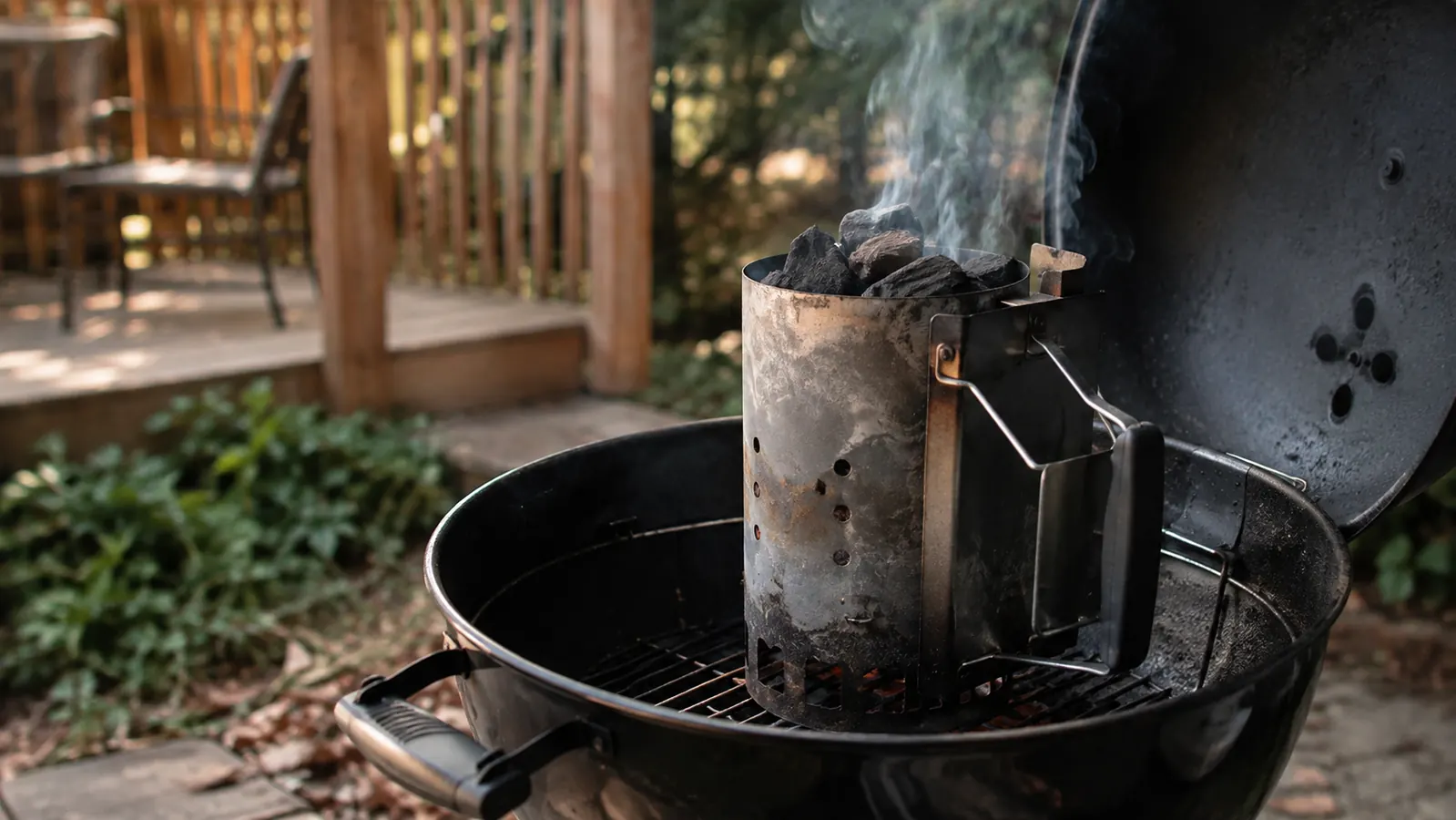
If you already own a charcoal grill and still reach for lighter fluid, this is the honest version of the story you hear after someone switches. I spent two full cooking seasons, and part of a third, with the Weber Rapidfire Chimney Starter on the deck behind our house in Dahlonega, Georgia. It is not a gadget that makes charcoal cook itself. It is a metal basket that solves the oldest problem in charcoal cooking, getting a pile of lump or briquettes to an even gray ready-to-cook state without the taste of lighter fluid.
I am 58 years old, a retired HVAC contractor, and I have cooked outside on the same wooden deck for more than twenty years. My main cooker is a 22-inch charcoal kettle that I bought used, and I also run an offset stick burner with a welded baffle. Neither cooker starts itself. On Sunday afternoons, and on most Friday evenings when the weather cooperates, the routine starts the same way: a chimney full of lump charcoal. For two seasons now, that chimney has been this Weber.
The Quick Verdict
For a cook who starts charcoal at least a few times a month, this chimney starter is the closest thing to essential in the whole charcoal setup. The fair warning is that it does not light itself, it makes ash, and it is heavy when full.
Amazon Check Today's Price →Skip Lighter Fluid Without Waiting All Evening
The Weber Rapidfire sits beside my kettle all season because it does one job well. It starts lump or briquettes evenly in about twenty five minutes, with no fuel taste and no electric cord to trip over. Check today's price if you cook with charcoal more than once a month.
Amazon Check Today's Price on Amazon →How I Used It
I did not build a lab test with thermocouples. My method was the one you will use: a chimney of lump charcoal over newspaper, set on the lower grate of the kettle or just in front of the offset firebox while the coals caught. I kept track of time with a glance at the kitchen clock, because that is how a Sunday cook actually measures things. I wanted to know three things: whether the starter made the grill more dependable, whether the food tasted cleaner, and whether the same chimney would still be worth keeping on the first cook of spring.
The usual meal on my deck is chicken, pork shoulder, burgers, or a few steaks for my wife Deb and whoever turns up. That usually means six to ten plates. I fill the chimney somewhere between half full and two thirds full for a normal kettle fire, which is enough coals for a packed grate. While the chimney does its work, I trim meat, make a rub, and set the table. By the time the prep is done, the top layer of the charcoal usually has the pale gray color that says it is ready.
For the offset smoker, I used the same chimney but dumped the live coals into the firebox on top of a few small oak splits. That gives me a cleaner starting fire than I used to get when I tried to build the fire in the firebox with paper and a few coals first. The chimney does not care whether its load ends up in a round kettle or a steel firebox. That is the reason it stays out on the deck rather than living in a cabinet.
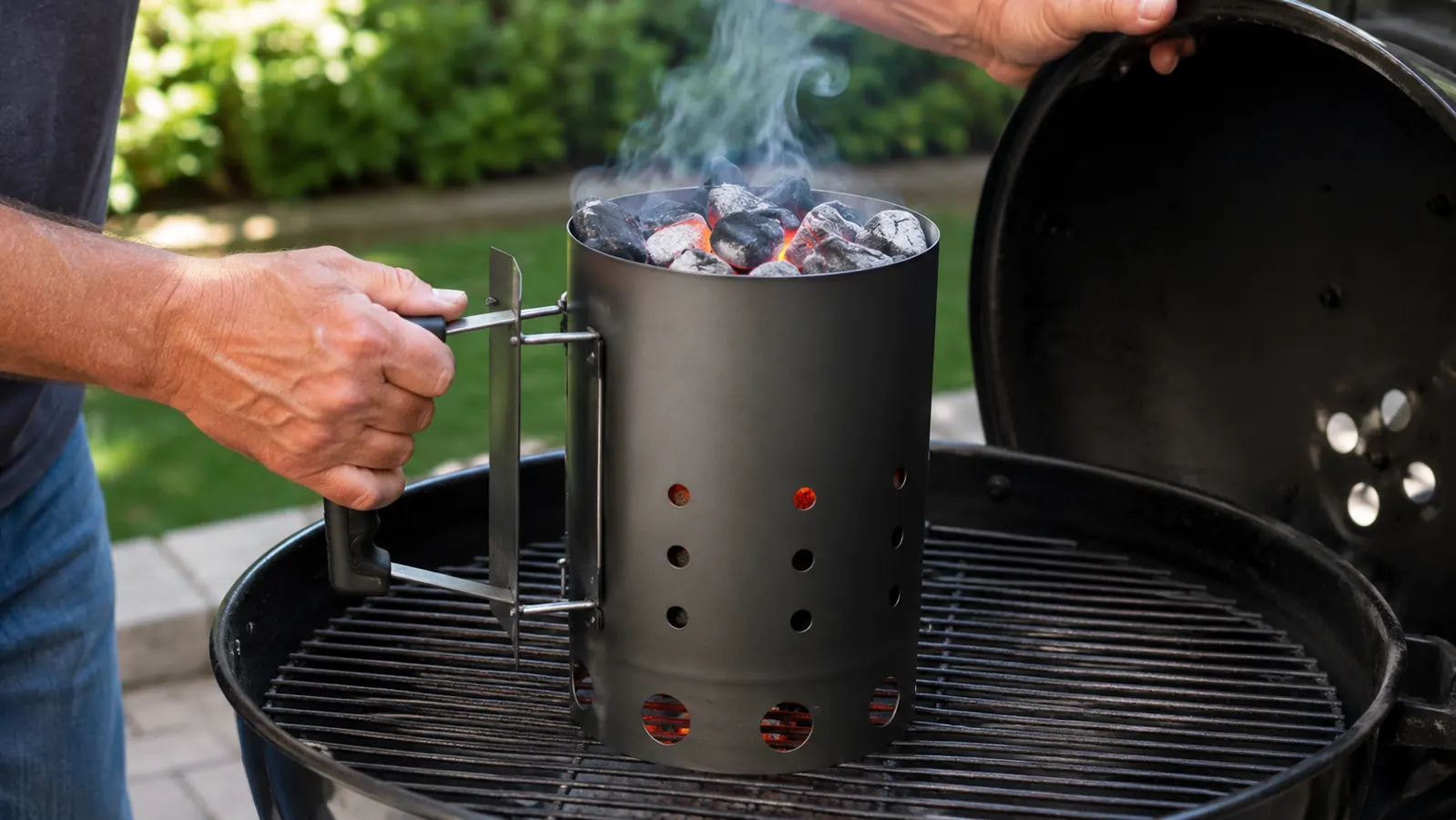
The number everyone asks about is light time. In calm weather with dry paper and lump charcoal, a full chimney showed an even gray coat in twenty three to twenty eight minutes. On a breezy evening, the chimney pulled harder and the same load was ready closer to eighteen minutes. On a damp night, with newspaper that had been sitting out too long, it took over thirty. Any review that quotes one number is describing one particular afternoon, not the tool.
What Most Reviews Skip
The positive reviews are not lying. This starter does what a starter should do. But most of those reviews are written after one cook, and they celebrate the idea of the thing. The parts that only show up with regular use are the parts worth knowing before you buy.
First, the chimney does not light itself. It is a metal basket with a handle, nothing more. You need dry newspaper or a fire starter, and you need a flame that can reach under the basket. I keep a long handled butane lighter near the grill. If you do not have a way to light the paper, buy that first, because the chimney starter will not help you on a windy night without a flame and dry paper.
Ash is the second topic. A chimney starter lets a fine gray dust fall through the open metal whenever you lift it or set it down. That is normal, not a reason to send it back. What matters is how you pour the live coals into the grill. Pour close to the charcoal grate. If you pour from high up, a puff of ash floats with the heat, and I have watched that ash drift toward meat that was already in place on the grate.
The next detail is weight. A full chimney is not dainty, because the steel has to be thick enough to last more than a couple of summers. That thickness is a good thing, but it means you should move a full chimney with two hands, or with one hand on the handle and a glove under the bottom. I set mine on a level paver or on the kettle grate, never on the edge of a flimsy table.
How It Compares to Lighter Fluid
The comparison that matters for most home cooks is not this chimney versus another chimney. It is chimney versus lighter fluid. Lighter fluid is faster on the surface. You spray, wait a few minutes, and light it, and flames roll over the charcoal. The problem is not the speed. It is what the fluid leaves behind. Coals that are still burning off the fuel carry a smell I could taste in the first meat that hit the grate. The more often I cooked, the less I was willing to make that trade.
The chimney makes a different trade and I now take it every time. It burns newspaper underneath the basket and pulls air up through the fuel. Twenty to thirty minutes later, I have an even bed of live coals that are ready to cook and show no sign of what started them. In exchange for that clean start, I give up lighter fluid's short wait. The chimney is not faster. It is cleaner and steadier, and once the coals are in the kettle, it saves time elsewhere because the fire behaves.
Where It Falls Short
If I need only a few coals for a single steak or a small skillet, the chimney is more tool than the job requires. You can put a small amount of charcoal in a chimney, and it works, but a small load does not catch as evenly as a larger load. This starter is comfortable with a load that is at least half full. That means it suits the cook who fires up charcoal a handful of times every month rather than the person who cooks over coals twice a year.
It will not fix bad fuel. The chimney only brings the charcoal up to temperature evenly. If the charcoal is damp, or if the briquettes have been stored outside in the weather, the fire will smoke and struggle no matter what starter you use. The foundation of good charcoal cooking is dry charcoal and dry paper. The chimney is the thing that turns that dry fuel into an even bed of live coals.
What I Wish I Knew Before My First Use
When I first cooked with a chimney starter, I made three avoidable mistakes. I filled the basket to the brim because it felt efficient, and then I had to move more weight than I needed. I carried it one handed and let the handle swing. I poured the coals from high up and watched ash carry across the grate. With regular use, I settled into a better routine. Fill the starter about two thirds full for a normal kettle cook. Move it with two hands or with a glove under the base. Pour the coals with the bottom of the chimney just above the charcoal grate.
The other thing I wish I knew is how little actual flame management the chimney needs. After the paper catches, the fire travels up through the chimney by itself. You do not need to poke it or fan it. You do need to keep an eye on it and keep the area around it clear. Set the chimney on the grill grate or on a solid paver, start the paper, and then go do your prep. It will do its job while you do yours.
What I Liked
- Lights a normal load of charcoal evenly with no lighter fluid involved.
- Sturdy steel that has held up for two seasons and looks ready for another.
- Works with lump charcoal or briquettes and feeds either a kettle or a firebox.
- No cord, no battery, no switch to fail.
- Simple to clean once you keep a metal bucket near the grill.
Where It Falls Short
- Needs dry newspaper and a separate flame before it does anything.
- Full chimney is heavy, and two hands are smarter than one.
- Fine ash can float onto food if you pour too high.
- Small loads catch less evenly than full loads.
In calm weather, this Weber starter took about twenty five minutes to turn a full load of lump charcoal into an even gray bed. In the wind it was closer to eighteen. That range is the honest picture.
How It Held Up
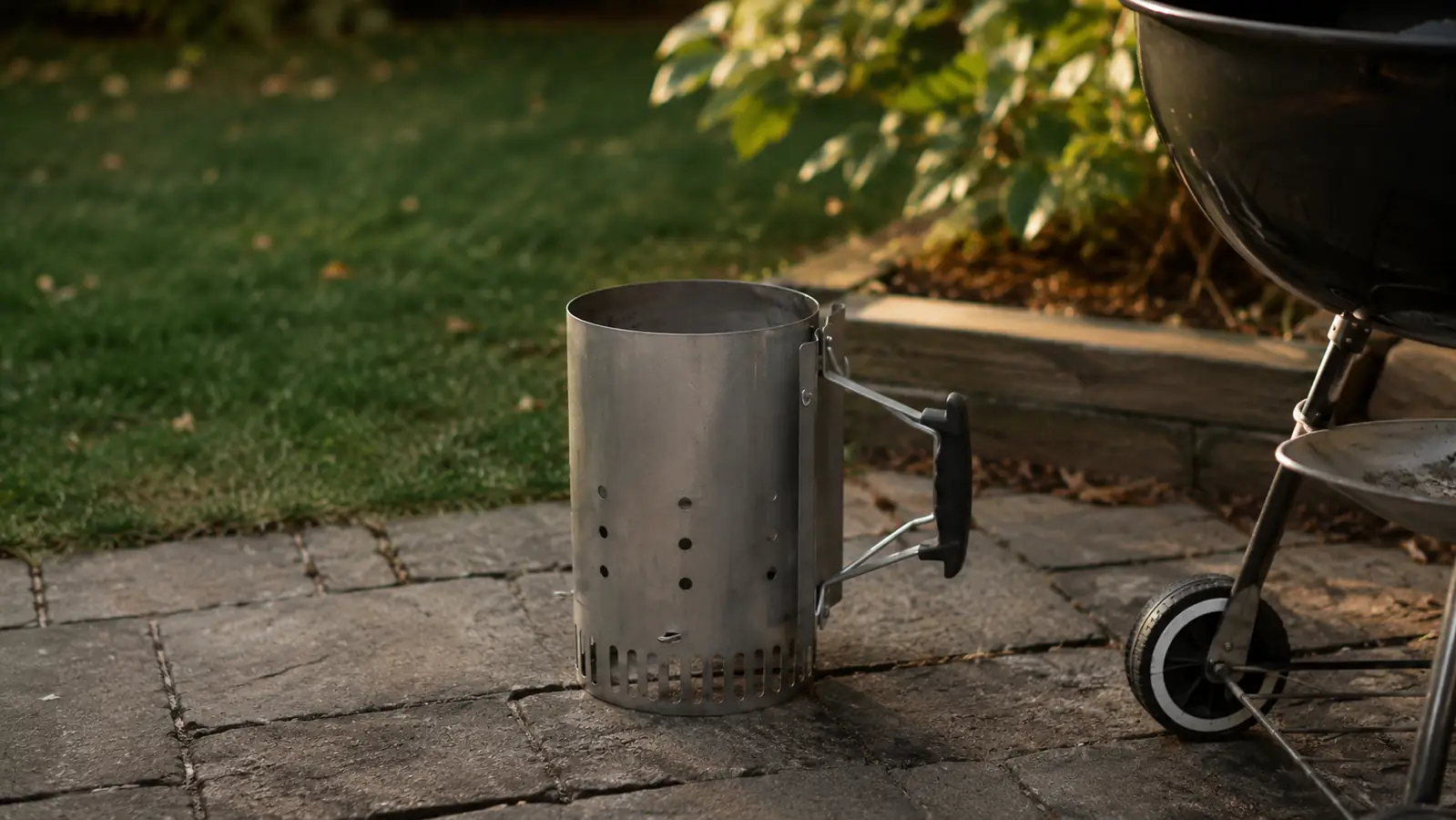
A full season and part of another is not a lifetime, but it is enough time for a tool to fail. This one did not fail. The steel held its shape, the handle still moves freely, and the bottom of the basket has not warped even though it gets set down on hot grates and left outside some nights. I am not gentle with outdoor gear, and this starter has asked for nothing more than a little routine care.
I did find one thing I do not enjoy. Ash collects at the bottom of the chimney and around the lower lip of the starter. If I let it sit too long, it mixes with a little moisture and becomes a paste that needs a rinse. That is not a design flaw. It is the simple cost of burning charcoal, and it cleans up with a hose. I mention it because the perfect reviews never mention it.
The Alternatives I Considered
I did not test every chimney starter made. I looked at cheaper versions and at fancier ones with folding handles and different vent patterns. In the end I came back to this Weber because the part that wears out first on a chimney starter is usually the handle or the basket, and both of those felt solid on this one. The vent pattern matters far less than the quality of the metal and the way the handle is attached.
I also considered going back to lighter fluid for the rare cold morning when I did not want to wait. I did not stay there. The chimney takes longer, but it gives me coals that are already even when they hit the kettle, and it does not put any fuel taste into the smoke. For the way I cook, that trade is worth the extra minutes. Those minutes are part of the Sunday routine now.
Who This Is For
This starter is for the cook who already owns a kettle or a charcoal smoker and uses it more than once a month. It is for the person who is tired of the smell of lighter fluid, or worried about what that smell does to the first few bites. It is for the cook who does not need dinner in fifteen minutes and does not mind spending twenty five minutes building a proper fire before cooking.
If you love the ritual part of grilling, the part where the grill is getting ready while you are getting ready, this chimney fits naturally into your routine. You can put the starter on the grate, light the paper, and let it work while you trim meat and pour the drinks. The social part of the Sunday cook can start before the meat ever reaches the fire.
Who Should Skip It
Skip it if you only grill over charcoal two or three times a year. The starter works fine on that schedule, but you will spend more time remembering how to load it than you will save. Skip it if every meal has to be ready in fifteen minutes from the moment you walk outside. A chimney starter will not compete with a gas grill for speed. Its advantage is steady even coals and cleaner taste, not quick hot coals.
One more kind of cook should think twice before clicking buy. If you own only a gas grill and you have no plan to cook over charcoal, a chimney starter will sit in the garage. It is a tool for charcoal, not a tool that creates a charcoal habit. Buy it when the kettle or the smoker is already in the picture and the only question is how to start the fire.
The Bottom Line
The Weber Rapidfire Chimney Starter is not the kind of product that changes your life. It is the kind of product that quietly makes every charcoal cook easier. You still have to light paper, wait twenty five minutes or so, and clean up ash. What you get back is an even bed of coals with no fuel smell, a method that works on a kettle or a firebox, and the confidence that you are not spraying chemicals onto the food you are about to grill. For me, that is the whole case for owning one.
See Today's Price on the Weber Rapidfire Chimney Starter
It takes a couple of minutes to set up and it takes about twenty five minutes to do its job. If you cook over charcoal a few times a month, this Weber belongs next to the grill. Check today's price on Amazon.
Amazon Check Today's Price on Amazon →